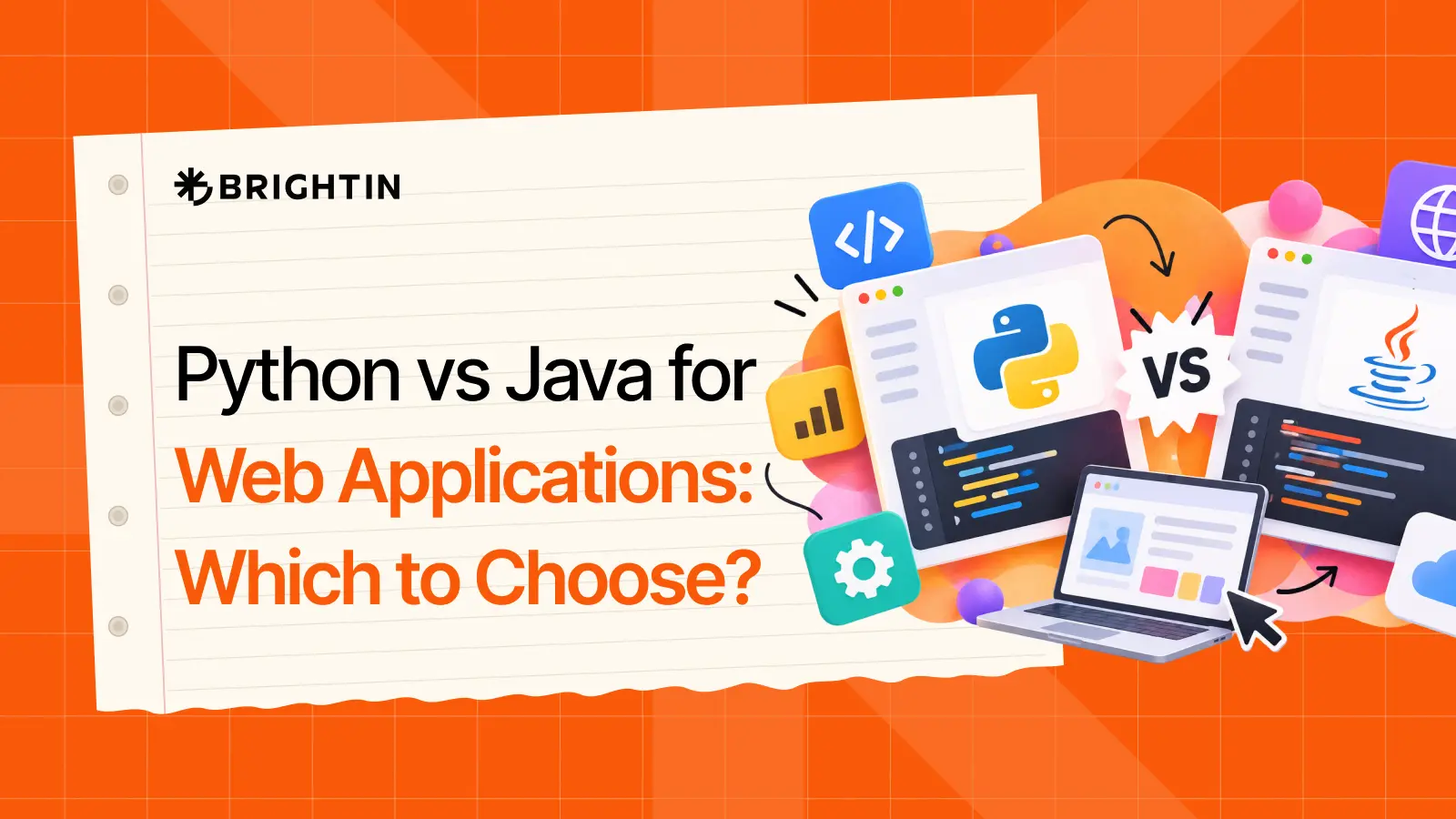
Python vs Java for web applications is one of the most common debates we hear from founders and product teams. Both languages are mature, safe choices. Both power huge websites. So picking one can feel harder than it should be.
The good news is that the right choice usually becomes clear once you look at your project, your team, and your growth plans. This guide compares both languages in plain English, without the heavy tech talk, so you can make a confident decision.
Python vs Java for Web Applications: The Quick Answer
If you need to launch fast, test an idea, or add AI and data features, Python is usually the better pick. If you're building a large, high-traffic system that must run for years, like a banking platform or a big business tool, Java is often the safer choice.
Many teams start with Python for an early product and bring in Java later for heavy parts. There's no single winner, just the right fit for your web app.
Python vs Java at a Glance
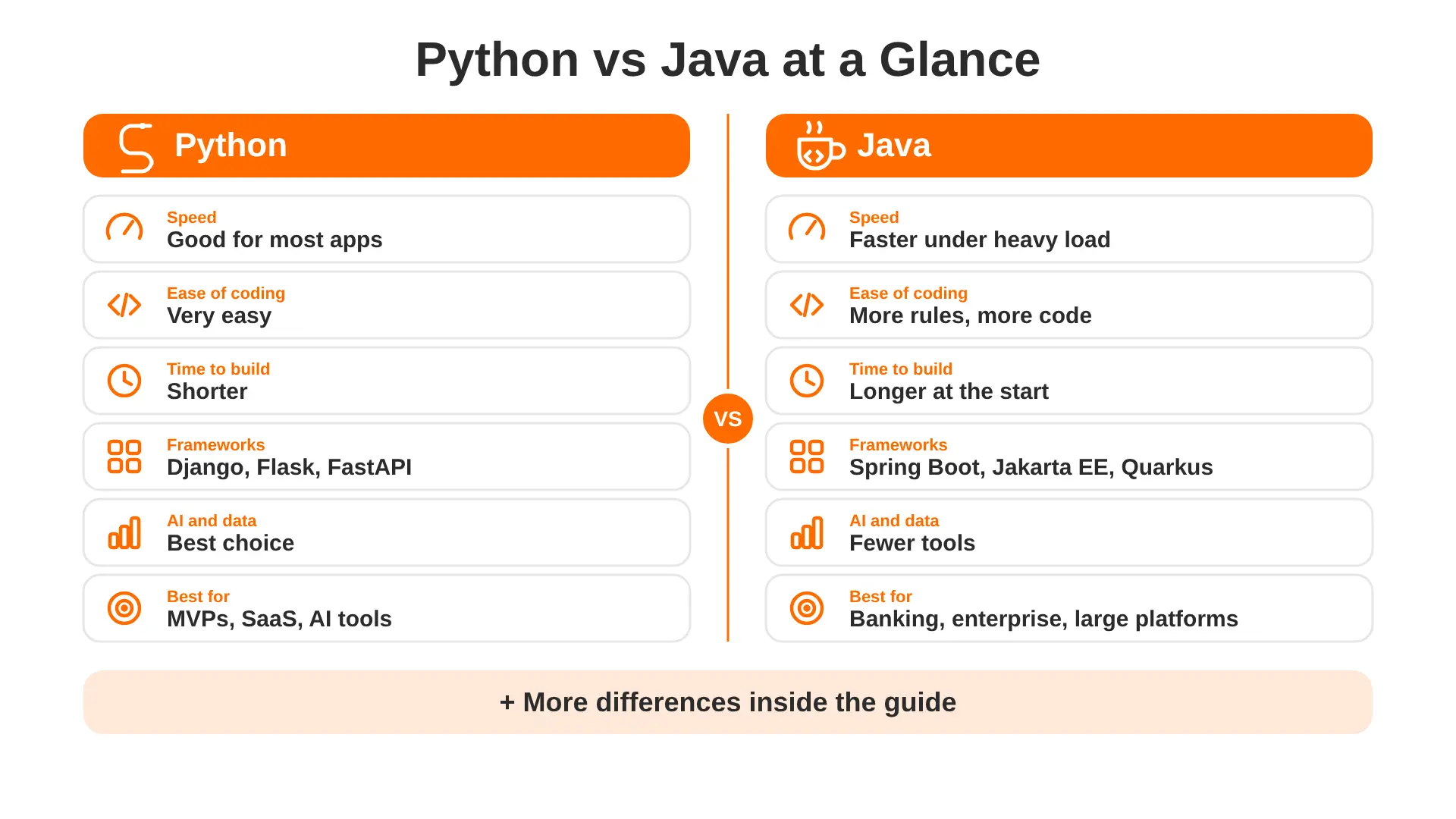
Here's a quick side-by-side comparison for web development.
What Is Python?
Python is a general-purpose programming language known for its clean, simple code. It reads almost like English, which is why so many beginners learn it first. But don't let that fool you. Instagram's backend was built on Django, a Python framework, and it serves a huge number of users every day.
Where Python Works Best for Web Apps
- Fast launches. You write less code, so features get built and tested quicker.
- MVPs and early-stage products. Great when you want to test an idea before spending big.
- AI, machine learning and data. Tools like pandas, TensorFlow, and PyTorch are all Python-first.
- APIs and back-office tools. FastAPI and Flask make small, fast services easy to build.
Where Python Falls Short
- Raw speed. For heavy calculations, Python is slower than Java.
- Running many tasks at once. Python has a built-in lock (called the GIL) that limits how it uses several processor cores. Newer versions are working to remove this, and async tools help a lot, but it still needs planning.
- Very large codebases. Without strict rules, a big Python project can get messy over time.
What Is Java?
Java has been around since the mid-1990s and is still one of the most used languages for business software. Java code runs on the Java Virtual Machine (JVM), a layer that lets the same code run on almost any server. Many banks, insurers, and large online platforms rely on Java for their main systems. Netflix, for example, runs much of its backend on Java.
Where Java Works Best for Web Apps
- High-traffic platforms. Java handles many users and requests at the same time very well.
- Enterprise and finance systems. Strict rules and checks make it a favourite for systems where mistakes are costly.
- Long-life products. Code that needs to run and grow for 10 years or more.
- Large teams. Clear structure makes it easier for many developers to work on one project.
Where Java Falls Short
- Slower to build. Java needs more code to do the same job, so early versions take longer.
- Harder to learn. New developers need more time to get comfortable.
- Heavier on memory. Java apps usually use more server memory, which can raise hosting costs for small projects.
Key Differences Between Python vs Java for Web App Development
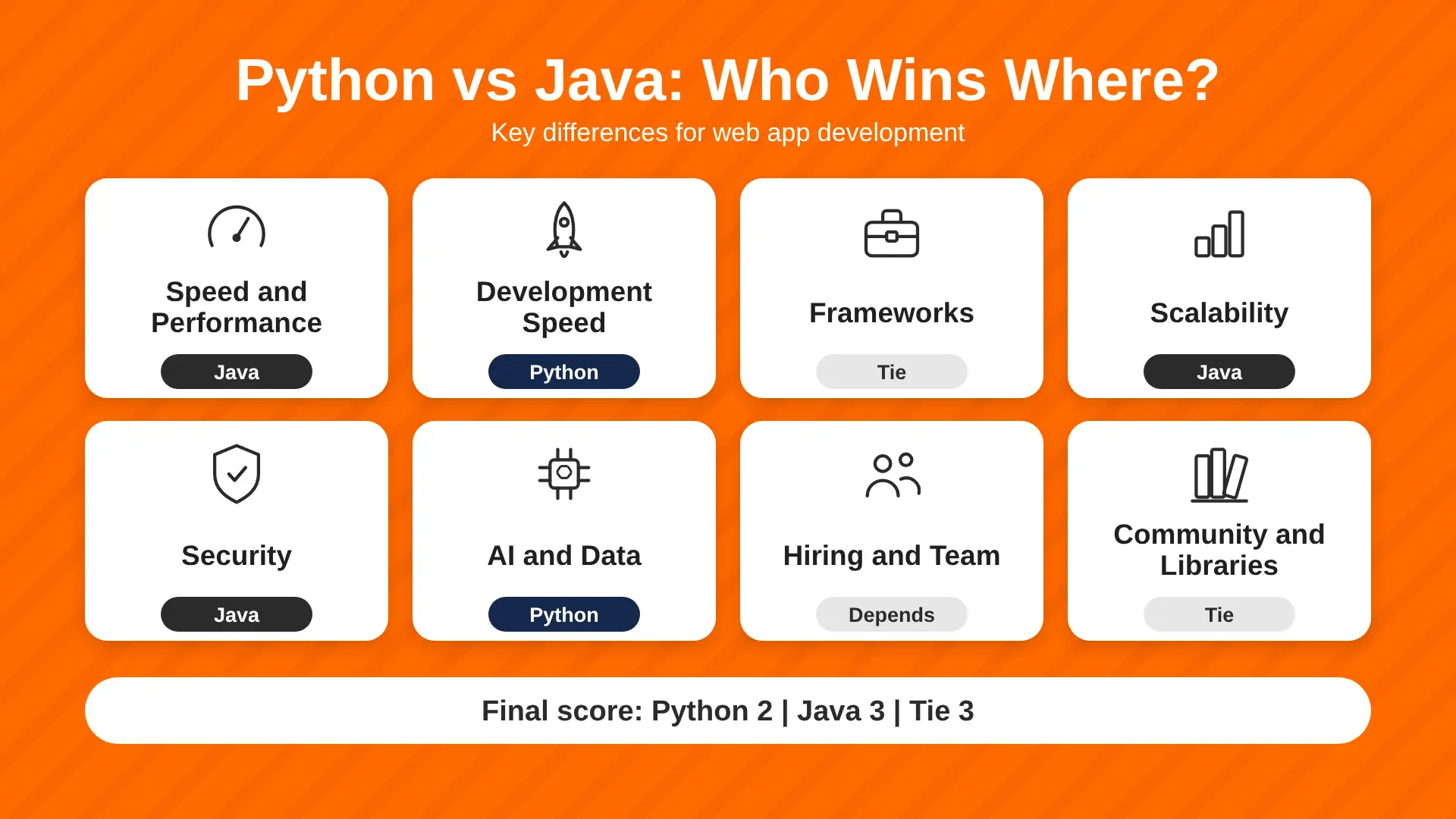
Here's how both languages compare on the points that matter most for web apps.
Speed and Performance
Speed means how quickly your web app handles a request and sends a reply. Here's how each language does.
Python
- Python reads and runs code line by line while the app is running, which adds extra work.
- It's fast enough for most everyday web apps, like booking sites, dashboards, and online shops.
- It slows down with heavy jobs, such as big reports, image processing, or lots of maths on the server.
- Its built-in lock (the GIL) stops it from fully using several processor cores at once, so busy apps often need more servers.
Java
- Java code is turned into bytecode before it runs, and the JVM speeds it up even more while the app is live.
- It handles heavy jobs and complex maths much faster than Python.
- It can use all the processor cores on a server, so one server can deal with many users at the same time.
- It stays fast under heavy traffic, which is why banks and trading platforms rely on it.
What this means in real life: In most web apps, the slow part is waiting for the database, a payment provider, or another service to reply. So a small or medium Python app can feel just as quick to users as a Java one. The gap shows up when you have thousands of requests every second, heavy server-side work, or real-time data feeds.
Winner: Java. It's faster when the load gets heavy. For most small and mid-sized web apps, though, users won't notice the difference.
Development Speed and Code Size
This is about how fast your team can build, test, and change features.
Python
- The same feature often needs far fewer lines of code than in Java.
- Its simple, clean style makes code quick to write and easy to read.
- Changes after user feedback can go live in days, not weeks.
Java
- It needs more code and more setup for the same feature.
- Its strict rules slow down the first build.
- That extra structure does help later, when the codebase gets big.
Winner: Python. If getting to market fast matters most, Python can save you weeks.
Frameworks: Django, Flask and FastAPI vs Spring Boot
A framework is a ready-made toolkit that handles common jobs like logins, forms, and database work, so developers don't start from zero.
Python
- Django comes with almost everything built in, including an admin panel, user accounts, and database tools.
- Flask is small and flexible, good for simple apps and small services.
- FastAPI is modern and quick, ideal for APIs and apps that call AI models.
Java
- Spring Boot is the most popular choice, with tools for security, data and cloud setups. The official Spring Boot project page shows how much it covers.
- Jakarta EE is the long-standing standard for large business systems.
- Quarkus and Micronaut are lighter options that start faster and use less memory.
Whichever backend you pick, it will work with any modern frontend. Our guide to the best frontend frameworks for web apps covers that side of the stack.
Winner: Tie. Django is quicker for getting a full app live. Spring Boot gives more control for very large systems.
Scalability and Handling Lots of Users
Scalability means how well your app copes as more people use it.
Python
- It can grow to millions of users, as Instagram shows.
- It usually needs more servers or containers as traffic rises.
- Busy apps need extra tools, like async frameworks, caching, and background jobs.
Java
- It was built from the start to run many tasks at the same time.
- Newer versions add "virtual threads", so one server can handle a huge number of requests.
- It grows with less extra setup when traffic gets very high.
Many large apps split into smaller services as they grow. These microservices best practices explain how to plan that.
Winner: Java. It scales with less effort once traffic gets very large.
Security
Both languages can be very secure. A lot depends on the framework and the team.
Python
- Django blocks common attacks like SQL injection, cross-site scripting, and cross-site request forgery by default. The Django overview lists these protections.
- Its flexible, dynamic style means some mistakes only show up when the code runs.
- Teams need good testing to catch errors early.
Java
- Spring Security gives strong, detailed control over logins, roles, and permissions.
- Its strict typing catches many mistakes before the code ever runs.
- It has a long track record in banks and payment firms.
Winner: Java, by a small margin. It has the edge for high-risk systems like payments.
AI and Data Features
Think recommendations, chatbots, document reading, or predictions inside your web app.
Python
- Almost every major AI and data tool, like TensorFlow, PyTorch, and pandas, is built for Python first.
- You can add AI features straight into a Django or FastAPI app.
Java
- It can call AI services through APIs, and Java AI libraries are growing.
- It has fewer ready-made tools and fewer examples.
- Teams often end up adding a Python service for AI anyway.
Winner: Python, by a wide margin.
Hiring, Team and Long-Term Maintenance
Both languages have large pools of developers in the UK and worldwide.
Python
- Developers are common in startups, data teams, and AI work.
- Small teams can move fast and cover a lot of ground.
- Big projects need good habits, like type hints, tests, and code reviews, to stay tidy.
Java
- Developers are common in banks, large firms, and enterprise projects.
- Its strict structure helps big teams keep code clean for years.
- New team members find it easier to follow code someone else wrote.
Winner: Python for small, fast teams. Java for large teams and long-life systems.
Community, Libraries and Support
A big community means more free tools and more help when your team gets stuck.
Python
- The Python Package Index (PyPI) has packages for almost anything, from payments to PDF reports.
- Tools move fast, so you get new features sooner.
- Packages need updating more often.
Java
- Maven Central is a massive library store used by enterprise teams for decades.
- Tools are very stable and change slowly.
Winner: Tie. You won't run short of help with either.
Which Costs Less to Build and Run?
We won't give made-up prices here, because the real cost depends on your features, team, and timeline. But we can show you what drives the cost for each language.
Python often costs less when:
- You need an MVP or first version quickly
- Your team is small
- The app is mostly forms, dashboards, content, or API work
- You plan to add AI features
Java can be better value when:
- The system must handle very high traffic for years
- Errors would be very costly, such as in payments or healthcare
- You already have Java developers or Java systems in place
Running costs to think about:
- Server memory: Java apps often need more memory per server.
- Number of servers: Python apps may need more servers under heavy load.
- Maintenance: cheap to build doesn't always mean cheap to maintain.
For a fuller picture of budgets, see our breakdown of what custom software development costs. If you're testing an idea first, our guide to MVP development costs is a good place to start.
Which Should You Choose for Your Web App?
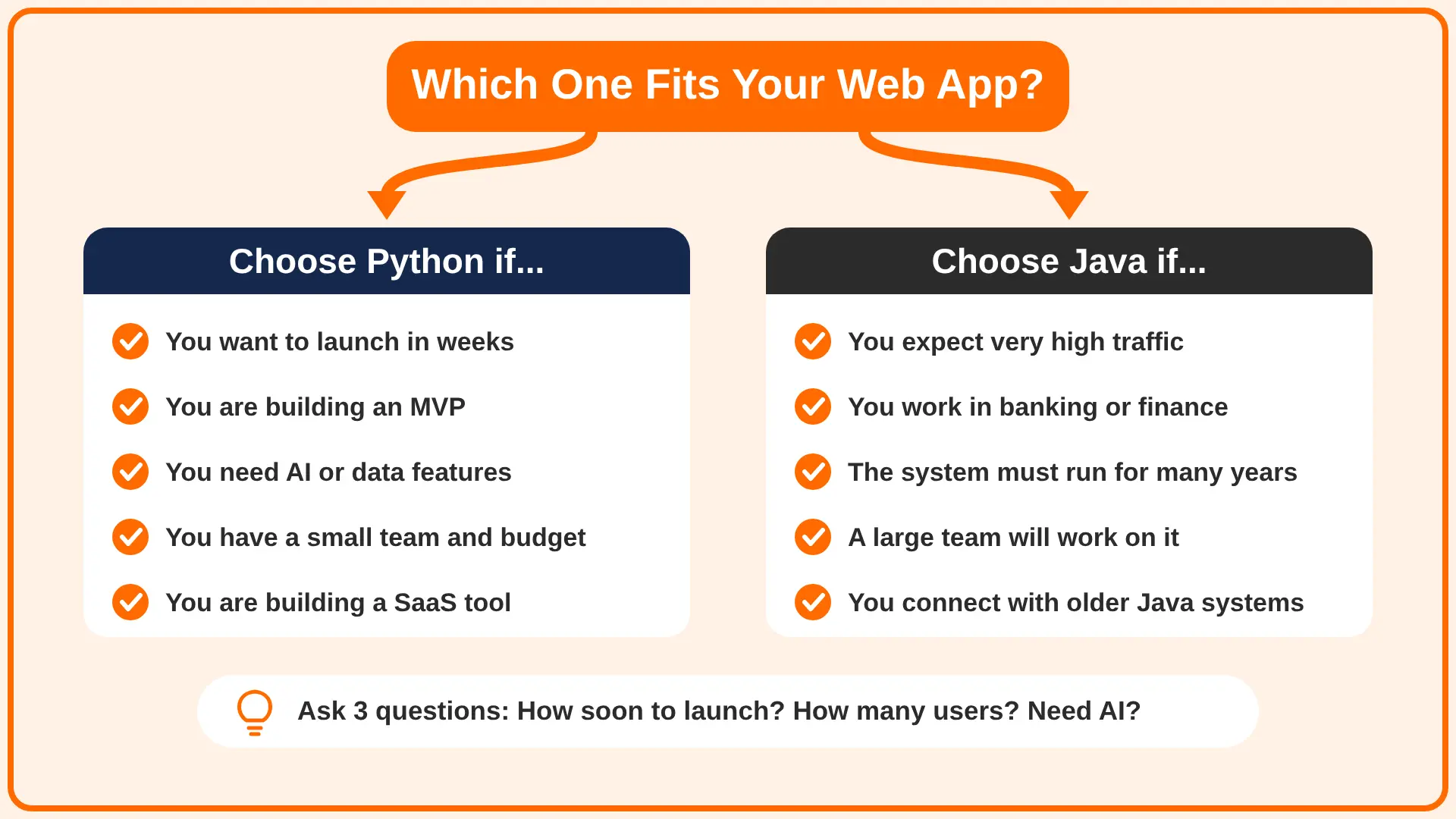
Here's a simple way to decide.
Choose Python if:
- You want to launch in weeks, not months
- You're building an MVP or testing a new idea
- Your app needs AI, machine learning, or heavy data work
- You have a small team and a tight budget
- You're building a SaaS tool, dashboard, or content platform
Choose Java if:
- You expect very high traffic from the start
- You're building for banking, insurance, or other regulated fields
- The system must run reliably for many years
- A large team will work on the code
- You need to connect with older enterprise systems that already use Java
Some real-world examples:
- A SaaS startup testing an idea: Python with Django or FastAPI. If that's you, this guide on how to build a SaaS product walks through the full process.
- A digital banking or payments platform: often Java with Spring Boot, thanks to its strict checks and strong security tools. Our fintech software development team works on this kind of system.
- A property portal with search and listings: either works. Python is faster to launch, and Java suits very large listing volumes.
- An AI-powered customer service tool: Python, because of its AI libraries.
- An internal tool for a large company: often Java, especially if the company already runs Java systems.
When we plan a new build with clients, we usually ask three questions first. How soon do you need to launch? How many users do you expect in year one? Will you need AI or data features? The answers point to the right language most of the time.
Common Mistakes When Choosing Between Python and Java
We see the same few mistakes again and again when teams pick a backend language.
- Choosing for speed you don't need yet. Picking Java "for scale" when you have no users can slow your launch by months. Many apps never reach the traffic where the speed gap matters.
- Ignoring your team's skills. A team that knows Python well will build a better Python app than a so-so Java app, and the other way round.
- Forgetting about AI plans. If AI features are on your roadmap, starting with Java can make them harder to add later.
- Copying big tech. What works for Netflix or Instagram may not suit a 5-person startup. Their needs and budgets are very different.
- Thinking you can never switch. With a clean API design, you can move heavy parts to another language later without a full rebuild.
Can You Use Python and Java Together?
Yes, and many large companies do. A web app doesn't have to use one language for everything.
A common setup looks like this:
- Java runs the core system, such as payments, accounts, and orders
- Python runs AI features, data reports, or recommendation engines
- The two talk to each other through APIs, which are simple ways for software to share data
This gives you Java's strength and Python's speed of building. The trade-off is more complex hosting and a team that knows both languages. For most small and mid-sized projects, sticking with one language keeps things simpler.
FAQs About Python vs Java for Web Development
Is Python or Java better for web development?
Neither is better for every project. Python is better for fast launches, MVPs, and apps with AI features. Java is better for large, high-traffic systems that need strict rules and long-term stability, like banking platforms. Your project size, team, and timeline should decide.
Is Java faster than Python for web apps?
Yes, Java usually runs faster, especially under heavy load or with complex calculations. But for most web apps, the database and network cause more delay than the language. A well-built Python app can feel just as fast to users as a Java one.
Is Django better than Spring Boot?
Django is faster to set up and comes with more built-in features, so it suits startups and quick builds. Spring Boot offers more control and is built for large, complex systems. Both are mature, secure, and well supported.
Which is better for a startup MVP?
Python is usually the better choice for an MVP. You can build and change features quickly, keep the team small, and add AI features easily. If the product grows a lot, you can move heavy parts to Java later.
Do big companies use Python for web apps?
Yes. Instagram's backend was built with Django, and many large firms use Python for web services, data platforms, and AI tools. Big companies often use Python and Java side by side, picking each one for the jobs it does best.
Final Thoughts
Python and Java are both strong choices for web applications. Python gets you to market faster and leads the way in AI and data. Java gives you speed, structure and stability for large, busy systems. Start with your goals, not the language, and the choice becomes much easier.
If you'd like help choosing the right stack for your project, our web application development company in the UK can review your idea and suggest the best fit. We also offer web application development services from first plan to launch.