.svg)



Building a custom MVP in 2026 usually costs between $15,000 and $150,000+ USD. The final cost depends on your product scope, chosen platform, design needs, technical complexity, and the team you hire.
A simple web MVP with one clear user journey may sit near the lower end. A fintech, marketplace, AI, or real-time product with several user roles and complex integrations can cost more.
An MVP is not a fixed package. It should include only what you need to test your main idea with real users. The right budget depends on what your first release needs to prove.
This guide explains realistic MVP development costs, timelines, key cost factors, and practical ways to use your budget well.
Quick answer: All figures in this guide are in US dollars (USD). A simple MVP may cost $15,000–$35,000, a medium-complexity MVP may cost $35,000–$75,000, and a complex MVP may cost $75,000–$150,000+. These are planning estimates, not fixed quotes.
Quick answer: All figures in this guide are in US dollars (USD). A simple MVP may cost $15,000–$35,000, a medium-complexity MVP may cost $35,000–$75,000, and a complex MVP may cost $75,000–$150,000+. These are planning estimates, not fixed quotes.
What Is an MVP?
A minimum viable product is the smallest useful version of a product that solves a specific problem for a defined group of users.
The word viable matters. An MVP is not a broken or poorly designed version of the final product. It should deliver one clear outcome reliably enough for real users to try it, provide feedback, and show whether the idea deserves further investment.
For example, the first version of a property marketplace might allow users to create an account, browse verified listings, filter by location, view property details, and send an enquiry. Mortgage tools, agent subscriptions, automated valuations, and advanced recommendations could wait until the core experience has been validated.
A good MVP helps you:
- Test your riskiest assumptions with real users
- Reach the market sooner
- Learn which features people actually value
- Give investors or partners something tangible to evaluate
- Avoid investing heavily in the wrong product direction
If you are planning a SaaS product specifically, our guide on building a SaaS product covers the complete process, architecture decisions, technology stack, and development costs.
MVP Development Cost by Complexity
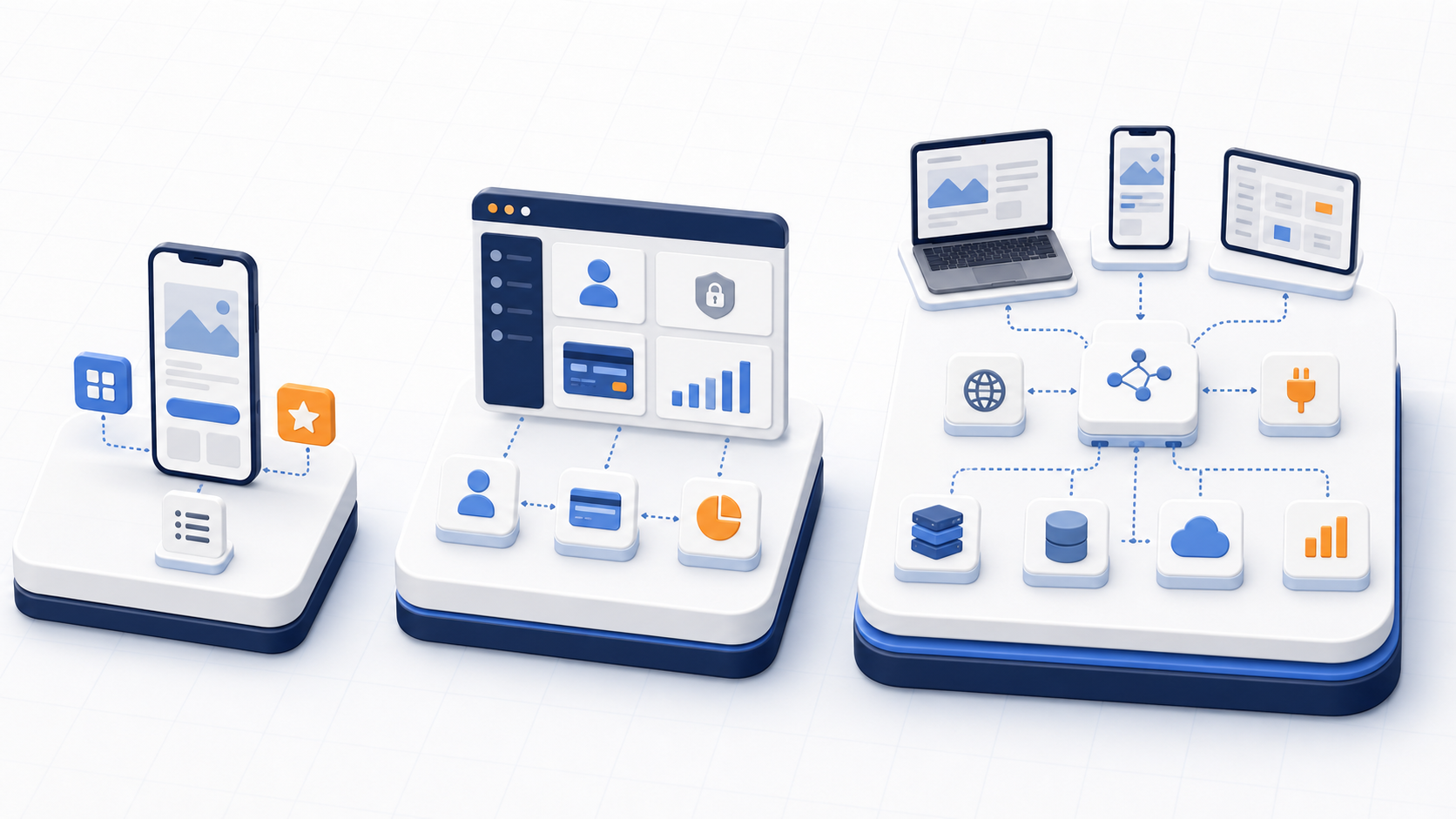
The best way to estimate an MVP is by its complexity, not only by the number of screens. A small product can still need complex data, integrations, user permissions, or security work behind the scenes.
Simple
- Typical scope: One platform, standard authentication, basic profiles, simple admin area
- Estimated cost: $15,000–$35,000
- Typical timeline: 6–10 weeks
Medium
- Typical scope: Custom UX, payments, dashboards, notifications, third-party services
- Estimated cost: $35,000–$75,000
- Typical timeline: 10–16 weeks
Complex
- Typical scope: Multiple user roles, AI, real-time features, regulated data, advanced integrations
- Estimated cost: $75,000–$150,000+
- Typical timeline: 4–8+ months
These ranges include the core work needed for a responsible product launch: planning, UI/UX design, development, testing, and deployment. They do not automatically include ongoing marketing, a large post-launch feature roadmap, or long-term product operations.
Simple MVP: $15,000–$35,000
A simple MVP focuses on one core journey and relies mostly on established technical patterns.
It may include:
- Email or social sign-in
- User profiles
- A basic database
- Content, listings, or simple submissions
- Search and basic filters
- A lightweight admin panel
- One responsive web application or mobile platform
Examples include a validation portal, a focused booking tool, an internal workflow product, or a niche directory.
Medium-complexity MVP: $35,000–$75,000
This level suits products that need several connected workflows or must serve more than one user type.
It may include:
- Custom dashboards
- Subscription or transaction payments
- Multiple roles and permissions
- Email, SMS, or push notifications
- Third-party API integrations
- File uploads and document handling
- More advanced reporting
- A custom component-based design system
Many early SaaS products, service marketplaces, and operational platforms fall into this category.
Complex MVP: $75,000–$150,000+
Complex MVPs often need specialised engineering or carry greater security, performance, and compliance risk.
They may involve:
- AI-powered workflows or recommendations
- Live chat, tracking, or collaboration
- Fintech payments and financial data
- Healthcare or other sensitive information
- Custom mapping and geospatial functions
- Multiple web and mobile applications
- Complex external systems
- High-volume data processing
- Detailed audit trails and security controls
The goal should still be minimum scope. “Complex” describes the technology needed to prove the idea—not permission to include every planned feature.
What Determines the Cost of an MVP?
1. Product scope
Scope is the biggest cost driver. Every new user role, workflow, exception, and admin function adds design decisions, development work, and testing.
Instead of asking, “Which features would be useful?”, ask, “Which features must exist for us to test our main assumption?” This question usually produces a much leaner first release.
2. Platform choice
A responsive web MVP is often the most efficient way to validate a new digital product. Building separate native iOS, Android, and web applications increases design, engineering, testing, and maintenance work.
The right platform depends on user behaviour. A field-service product may genuinely need mobile device capabilities, while a B2B reporting platform may be better suited to the web.
3. UI/UX design
Design cost depends on the number and complexity of user journeys, not simply visual polish. Research, information architecture, wireframes, prototypes, accessibility, responsive behaviour, and a reusable design system all require time.
Skipping UX work rarely removes the cost. It usually transfers that cost into development revisions, user confusion, and rework after launch.
4. Backend and data complexity
A product that stores basic profiles and content is very different from one that processes transactions, synchronises several databases, or calculates results in real time.
Data models, permissions, business rules, background jobs, search, reporting, and performance requirements can substantially affect the estimate—even when users see only a simple interface.
5. Third-party integrations
Using established services for payments, authentication, email, maps, analytics, or video can reduce development time. However, each integration still needs setup, secure implementation, error handling, and testing.
An integration becomes more expensive when its documentation is weak, the data is inconsistent, or it must support many unusual scenarios.
6. Security and compliance
All products need sensible security. Products handling payments, personal documents, medical information, or regulated financial activity need additional controls and validation.
Encryption, audit logs, consent management, data-retention rules, role-based access, penetration testing, and compliance support can add meaningful cost—but ignoring them can be far more expensive.
7. The team you hire
Freelancers, an in-house team, and a product development studio offer different cost structures.
Freelancer
- Best suited to: A tightly defined task or very small prototype
- Main consideration: You may need to manage strategy, design, engineering, and quality yourself
In-house team
- Best suited to: A funded company with continuous long-term development
- Main consideration: Recruitment, salaries, tools, and management increase the initial commitment
Product studio
- Best suited to: Founders who need strategy, design, engineering, and launch support together
- Main consideration: Choose a team with a clear process and relevant product experience. Brightin Studio helps startups turn ideas into production-ready digital products through product strategy, UI/UX design, and full-stack development.
The lowest hourly rate does not always produce the lowest total cost. Communication gaps, poor architecture, and repeated rework can quickly eliminate the apparent saving.
What Does the MVP Development Process Look Like?

A well-run MVP project generally follows six stages.
1. Discovery and validation
The team defines the user, problem, business goal, competitors, risks, and evidence needed from the first release. The output is a shared product direction—not just a list of requested features.
2. Scope and technical planning
Features are prioritised, user stories are clarified, the architecture is outlined, and third-party services are selected. This is where the initial estimate becomes more reliable.
3. UX and UI design
The team maps core journeys, creates wireframes, tests a prototype, and designs the final interface. Decisions made here reduce ambiguity during engineering.
4. Development
Engineers build the front end, backend, database, integrations, and admin functions in planned iterations. Regular demos keep progress visible and allow early feedback.
5. Quality assurance
The product is tested across devices and browsers. The team checks functionality, permissions, edge cases, performance, security, and the most important user journeys.
6. Launch and learning
After deployment, analytics and user feedback reveal where people succeed, hesitate, or leave. These findings should shape the next product decisions.
For example, our Propertio property management platform demonstrates how a focused product idea can evolve into a scalable SaaS solution through strategic design and development.
Costs Founders Often Forget
The development estimate is only one part of the launch budget. Depending on the product, you may also need to plan for:
- Cloud hosting and data storage
- Domain names and email services
- Payment, mapping, AI, messaging, or analytics fees
- App store accounts and review requirements
- Legal documents and compliance advice
- Security assessments
- Customer support and product operations
- Maintenance, monitoring, and bug fixes
- User acquisition and launch marketing
Maintenance does not have one fixed cost. Set aside a monthly or quarterly budget based on your number of users, release schedule, support needs, hosting, and third-party tools. Products that handle frequent transactions, live data, or regular feature releases usually need more ongoing support.
How to Reduce MVP Cost Without Reducing Quality

Build around one valuable outcome
Your MVP does not need to solve the entire market. It needs to complete one important job for one clear user group. A narrower promise makes the product easier to explain, design, build, and test.
Prioritise by evidence
Classify proposed features as essential, useful later, or unproven. If removing a feature does not prevent the core user from receiving value—or prevent the business from testing its main assumption—it probably does not belong in version one.
Prototype before development
Testing a clickable design is much less expensive than rebuilding working software. A prototype can uncover confusing navigation, missing steps, and weak assumptions before engineering begins.
Use proven services where they create no advantage
You usually do not need to build authentication, payment processing, email delivery, or analytics from scratch. Proven services can shorten the timeline and reduce risk. Custom engineering should focus on what makes the product valuable and different.
Launch to a controlled group
A pilot group gives you focused feedback without the operational pressure of a large public launch. It also allows the team to fix critical issues before acquisition spending increases.
Keep the architecture ready for growth—not imaginary scale
Your MVP should be maintainable, secure, and capable of sensible growth. It does not need infrastructure designed for millions of users on day one unless your launch genuinely requires it.
How to Get a More Accurate MVP Estimate
Before approaching a development partner, prepare a short brief that answers:
- Who is the primary user?
- What problem does the product solve?
- What is the single most important user journey?
- Which features are essential for the first release?
- Which platforms are required?
- Are there necessary integrations or compliance requirements?
- What do you need to learn from the MVP?
- Is there a target launch date or budget range?
You do not need a complete technical specification. A good product team should help turn business goals into a sensible scope. But clearer inputs lead to a more useful estimate and fewer assumptions.
Is Building an MVP Worth the Investment?
An MVP is worthwhile when it is designed to produce evidence. That evidence may be user adoption, completed transactions, retained usage, operational savings, or willingness to pay.
It is less valuable when it becomes a smaller copy of an oversized product plan with no clear experiment behind it.
The best MVP is not necessarily the cheapest version you can launch. It is the most focused version that can test your product’s critical assumptions while creating a credible experience for early users.
Frequently Asked Questions
How much does a basic MVP cost?
A professionally developed basic MVP commonly costs $15,000–$35,000. This usually covers one platform, a focused workflow, standard user accounts, a basic backend, testing, and deployment.
Can I build an MVP for less than $15,000?
Possibly. A no-code experiment, landing-page test, clickable prototype, or very narrow internal tool may cost less. However, it should not be compared directly with secure, maintainable custom software ready for real customer use.
How long does MVP development take?
A focused MVP often takes 6–16 weeks. Complex products may require four to eight months or longer. The timeline depends on scope, team capacity, integrations, decision speed, and compliance needs.
Should I build a web app or mobile app first?
Choose the platform that best fits the core user behaviour. A responsive web app is often faster to validate across devices. Native mobile is more appropriate when the product depends on mobile hardware, location, offline use, or frequent on-the-go interaction.
What should happen after the MVP launches?
Measure user behaviour, interview users, fix critical friction, and compare the evidence with your original assumptions. The next roadmap should be based on what you learn—not automatically on the longest-standing feature requests.
Get an MVP Estimate for Your Product
There is no useful one-price answer for every MVP. A reliable estimate requires a clear view of the user, core journey, technical risks, and evidence the first release must produce.
Brightin Studio helps startups and businesses turn validated ideas into production-ready digital products through product strategy, UX design, and full-stack development.
Planning an MVP? Talk to Brightin Studio to clarify the scope, timeline, and realistic development budget.