Choosing a frontend framework can feel hard. There are many tools, and each one has a different strength. Some are good for a large business app. Some are better for a small product. Some help public pages load fast and show well in search results.
The best frontend frameworks for web applications depend on your app, your users, and your team. A small startup does not need the same tool as a large bank. A public ecommerce site does not need the same setup as a private staff portal.
If you are planning web application development, choose a framework early. It affects how fast you can build, how easy the app is to update, and how simple it is for new developers to understand later.
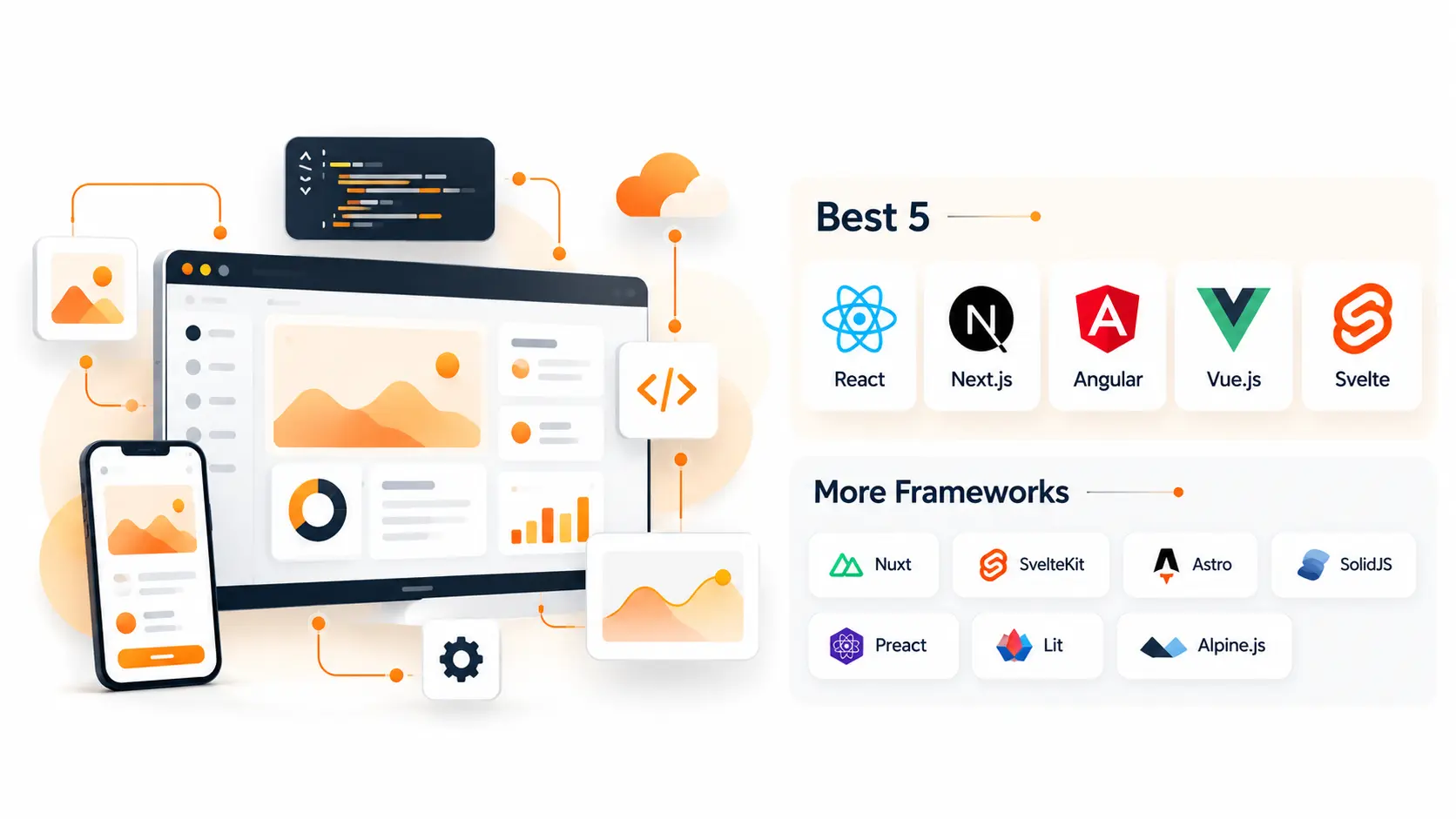
This guide covers 12 useful frontend tools for modern web applications. It explains what each one does, where it fits, and when another option may be better.
Quick Answer: Which Frontend Framework Is Best?
There is no one best choice for every project.
React is a safe choice for many business apps because it has a large ecosystem. Angular is strong for large and structured enterprise systems. Vue is easy to learn and works well for many small and mid-sized products. Next.js is useful when a React project also needs public pages, search visibility, and fast first loads.
Svelte and SolidJS are good when speed and a small code bundle matter a lot. Nuxt gives Vue projects more structure for public pages. Astro works well for content-heavy websites. Alpine.js and Lit are useful for smaller, focused jobs.
The right choice should match your product plan. It should also match the people who will build and maintain the app.
Frontend Framework, Library and Meta-Framework: What Is the Difference?
The frontend is the part of a web app that people see and use. It includes buttons, forms, menus, charts, pages, and messages.
A frontend library gives developers building blocks for the user interface. React is a common example. It helps teams build screens from reusable parts.
A frontend framework gives more rules and tools. Angular, for example, has a clear way to build routes, forms, and larger app features.
A meta-framework sits on top of another tool. Next.js uses React. Nuxt uses Vue. SvelteKit uses Svelte. These tools add useful features such as routing, server rendering, and page generation.
This difference matters in web and SaaS development. A private dashboard may work well with a simple client-side app. A SaaS product with public pages, help articles, and search traffic may need server rendering too.
Frontend Framework Comparison at a Glance
The 12 Best Frontend Frameworks for Web Applications
1. React: Best for Complex Product Interfaces
React is a user interface library. It lets teams build an app from small reusable parts called components. A search bar, dashboard card, payment form, or user profile can each become a component.
React is a good fit for SaaS dashboards, customer portals, ecommerce products, and apps with many moving parts. It has a large community and many tools for common jobs.
The main benefit is flexibility. Teams can choose their own routing, forms, data tools, and design system. This can be helpful when an app has special needs.
React also needs clear planning. It does not decide every part of the app for you. For a full product, teams often use React with a meta-framework such as Next.js. React’s official documentation also describes it as a library for building web and native user interfaces.
Use React when you need a rich and flexible product interface. Consider another option when your team wants more rules built in from the start.
2. Angular: Best for Large Enterprise Applications
Angular is a full framework for building large web applications. It gives teams clear patterns for forms, routing, testing and data work.
It is a good choice for internal business systems, finance tools, staff portals and products with many users and roles. Larger teams often like Angular because it gives everyone a shared way to organise the code.
Angular uses TypeScript and has strong built-in tools. This can help teams catch mistakes earlier. It can also make a large codebase easier to manage over time.
The trade-off is learning time. Angular has more concepts than some other tools. A small team building a basic first version may find it too heavy.
Use Angular when your product has a large scope, strict rules, and a long future. For a quick MVP, React, Vue, or SvelteKit may feel easier.
3. Vue.js: Best for Easy Adoption and Flexible Builds
Vue is a progressive frontend framework. It is known for clear syntax and a gentle learning path. Developers who know HTML, CSS, and JavaScript can often understand Vue quickly.
Vue works well for small and mid-sized web applications. It is useful for startup products, customer portals, booking tools, and existing websites that need more interactivity.
One strength of Vue is that you can use a little or a lot of it. A team can add Vue to one part of an older website. It can also use Vue for a full product interface.
Vue has useful tools for routing and state management. It gives teams a good balance between flexibility and structure.
Use Vue when your team wants a smooth start without giving up the ability to grow. It may be less suitable when your project needs a very large pool of third-party tools or React-specific developers.
4. Next.js: Best for SEO-Focused React Web Apps
Next.js is built on React. It adds routing, server rendering, static pages, and image tools. These features are useful when people need to find your pages through search.
For example, an e-commerce site may have public product pages, blog posts, and category pages. A SaaS business may have marketing pages, help content, and a logged-in product area. Next.js can support both public and private parts of the product.
It is also useful when page speed matters. A server can prepare more of the page before it reaches the visitor’s browser.
Next.js is not always needed for a simple private dashboard. It adds more choices and setup. Still, it is a strong option for a React product with public content and long-term search goals. The Next.js documentation covers server and client components, routing, data fetching, and image optimisation.
Use Next.js when React, SEO and public-facing pages need to work together.
5. Nuxt.js: Best for SEO-Focused Vue Projects
Nuxt is a framework built on Vue. It gives Vue teams tools for routing, server rendering, and static page generation.
It is useful for content-rich sites, e-commerce projects, and public web apps where fast first loads matter. Nuxt can also work well for a product that has both public pages and private user areas.
Nuxt gives Vue developers more structure without changing the Vue style they already know. This can make it a good choice for teams that prefer Vue but still need strong search and page performance support.
Use Nuxt when you want Vue with more built-in product features. It is less useful when your team already works mainly with React or does not need server-rendered pages.
6. Svelte: Best for Lean and Fast Interfaces
Svelte takes a different path from many frontend tools. It does more work while the app is built, so the browser gets less framework code later.
This can help make pages feel quick. Svelte is useful for interactive products where bundle size and speed matter. It can fit consumer apps, small product tools, and focused user journeys.
Svelte has a simple writing style. Many developers find it easy to read. It also has less boilerplate than some larger frameworks.
The main business question is team support. Svelte has a smaller hiring pool than React, Angular or Vue. If several teams will maintain the product for many years, that should be part of the decision.
Use Svelte when a lean front end matters and your team is comfortable with the ecosystem.
7. SvelteKit: Best for Full-Stack Svelte Products
SvelteKit adds production tools to Svelte. It gives developers routing, server rendering, form handling, and deployment support.
It is useful for a SaaS product, customer portal, or content-led web app that needs more than a simple browser interface. It helps teams build public pages and logged-in areas in the same product.
SvelteKit is a better starting point than plain Svelte for many new apps. It gives the project a clearer structure from day one.
Use SvelteKit when you want Svelte’s lean style with full application features. Make sure your team has enough Svelte knowledge before making it the long-term choice.
8. Astro: Best for Content-Heavy Websites
Astro is a strong choice for websites where most pages are content. This includes blogs, documentation sites, product pages, campaign sites, and marketing websites.
Astro sends less JavaScript by default. It only adds interactive parts where they are needed. A page can stay light while still using a search box, pricing tool, or form.
It can also use components from other tools such as React, Vue, and Svelte. This is useful when a team already has components it wants to keep.
Astro is less suited to a complex app where users spend all day in a dashboard. It can support interactive areas, but that is not its main strength.
Use Astro when page speed, content, and search visibility are central to the project.
9. SolidJS: Best for Fast Reactive Interfaces
SolidJS is a frontend library for highly reactive interfaces. It updates only the small part of the page that changes. This can be useful for live data, charts, messages, and real-time tools.
Its style may feel familiar to people who know React. However, it works differently behind the scenes. It does not use the same virtual DOM approach.
SolidJS can be a good choice for a performance-focused app. It is especially useful where small updates happen often, and the interface needs to stay smooth.
The ecosystem is smaller than React, Vue, or Angular. That can make hiring and long-term support harder for some businesses.
Use SolidJS when speed is a core product need, and your team is happy to work with a smaller community.
10. Preact: Best for Lightweight React-Style Projects
Preact is a small alternative to React. Its style is close to React, so it can feel familiar to React developers.
It is useful when page size matters. This can include product pages, embedded widgets and apps used on slow connections. It can also work well for smaller user interfaces that do not need a heavy setup.
Preact may help when a team likes React’s component style but wants less code sent to the browser.
It is not always the best choice for a large product. Some React tools may need extra checks before use. Teams should test important libraries early.
Use Preact for lightweight interfaces and focused builds. Use standard React when broad library support is more important.
11. Lit: Best for Web Components and Design Systems
Lit helps teams build web components. A web component is a reusable part of a page that can work across different projects and tools.
This is useful for a company with several websites or apps. For example, a shared button, form field, date picker, or checkout element can be built once and used in many places.
Lit works well for design systems and mixed technology teams. One product may use React while another uses Vue. Shared Lit components can help both.
Lit is not a full app framework. It does not replace a full routing and data setup for a large SaaS product.
Use Lit when reusable interface parts are the main goal. Pair it with another framework when building a full web application.
12. Alpine.js: Best for Small Website Interactions
Alpine.js is a small tool for adding interactivity to normal HTML pages. It can power a dropdown, modal, tab, form step, or simple filter without building a full single-page app.
It is useful for server-rendered websites. A business site may need a mobile menu, pricing toggle, or contact form that feels smoother without a large frontend setup.
Alpine is easy to add to an existing site. It can save time for small jobs.
It is not made for a complex SaaS dashboard, deep app routing, or large shared state. Trying to force it into a big product can create problems later.
Use Alpine.js when you need small, clear interactions on a website.
How to Choose the Best Frontend Framework for a Web Application
Start with the product, not the tool.
First, think about the type of app. A SaaS dashboard with many user roles may need React or Angular. A public e-commerce site may work well with Next.js or Nuxt. A simple content website may be better with Astro.
Next, think about your users. Will they use the app on older phones or slow networks? If yes, page weight and load time matter more. Svelte, Astro, Preact, and SolidJS may be worth closer review.
Then, look at your team. A strong framework is not useful if no one can maintain it. Check what your developers know now. Also think about future hiring, handover, and support.
Search visibility is another key point. If people must find your public pages on Google, a meta-framework can help. Next.js, Nuxt and SvelteKit give teams more options for server rendering and static pages.
Finally, plan for the next two years. A cheap first choice can cost more later if it is hard to update or hire for. Build a small proof of concept before you make a final decision. Test one real user flow, such as sign-up, search, or checkout.
Best Frontend Framework by Web App Type
A SaaS product often needs more than a nice dashboard. It may need user roles, billing, data security, integrations, and a public marketing site. Our guide on how to build a SaaS product explains how product scope, technology, and cost should work together.
Common Mistakes When Choosing a Frontend Framework
Do not choose a tool only because it is popular. Popular tools can be a good sign, but they may not fit your product.
Do not ignore the people who will maintain the app. A small specialist framework can be a good choice, but only if your team can support it.
Do not leave SEO decisions until the end. If public pages matter, plan for page rendering early.
Do not build too much before testing. A small proof of concept can show whether a framework fits your real needs.
Do not forget accessibility and security. These are not features that a framework can fully solve on its own. Your team still needs good design, testing, and safe coding habits.
Frequently Asked Questions
What is the best frontend framework for web applications in 2026?
React is a strong general choice for many web applications. Angular is useful for large enterprise systems. Vue is a good option for teams that want a simpler learning path. Next.js is useful for React apps with SEO needs. The best choice depends on your product and team.
Is React still a good choice for web apps?
Yes. React is still useful for dashboards, e-commerce products, customer portals, and SaaS tools. It has a large ecosystem and many developers know it. For a full product, React is often used with a framework such as Next.js.
Which frontend framework is best for SEO?
Next.js, Nuxt, and SvelteKit are strong choices when SEO matters. They can support server-rendered and static pages. Astro is also useful for content-heavy sites that need fast page loads.
Which frontend framework is easiest to learn?
Vue and Alpine.js are often easier for people who know basic HTML, CSS, and JavaScript. Svelte also has a simple style. Angular usually takes more time because it has a larger set of built-in concepts.
Final Thoughts
The best frontend framework is the one that fits the work in front of you. Think about your app type, users, team, search needs, and plans before you decide. A business looking for a web application development company in the UK should expect the technology choice to follow the product plan, not a one-size-fits-all rule.