Fintech app development cost depends on what the app needs to do. For early planning, the example budgets in this guide run from 40,000–100,000 for a focused first release to 250,000–500,000+ for a complex platform. These are illustrative estimates based on assumed work hours and a $50 hourly rate. They are not fixed quotes or market averages.
A spending tracker has very different needs from an app that moves money or handles loans. Design, data, security, and bank connections all affect the work involved.
Below, we break down the build budget, explain what changes it, and show which costs continue after launch.
All prices in this guide are in US dollars (USD).
How Much Does Fintech App Development Cost in 2026?
Start with the work your first release must include. A minimum viable product, or MVP, is a small working version that helps you test your idea with users. It still needs the checks and controls required for its purpose.
The table below assumes a rate of $50 per hour across planning, design, development, testing, and project management. Real teams charge different rates and may estimate different hours for the same brief.
For example, 1,600 hours at $50 per hour gives a build budget of $80,000. At $75 per hour, the same effort costs $120,000. The hourly rate and the amount of work both matter.
These budgets include initial design, build, testing and release work. They exclude ongoing provider fees, hosting, legal advice, licence fees, external audits and marketing unless added to the brief. Taxes and any funds you must hold to meet financial rules also sit outside these figures.
A full banking business can need far more than a mobile app. Before comparing prices, check whether a proposal covers the customer interface, the systems behind it, or both.
Fintech App Development Cost by App Type
An app's label tells only part of the story. Two payment apps may look similar but use different providers, support different markets, and handle very different risks.
Use these examples to find a starting point. The ranges use the same assumed $50 hourly rate as the first table and describe the stated scope, not every product in that category.
The lower end assumes a tight scope and usable third-party services. It does not cover building a bank, payment network, or trading exchange from scratch.
Small details can shift these figures. A budgeting app with manual entries needs less integration work than one that pulls data from many banks. A lending app with staff reviewing each case differs from one that makes automated decisions.
For a wallet, ask whether users can hold funds, send money abroad or use several currencies. For an insurance app, clarify whether users only submit claims or also buy and renew policies. These choices change the tasks, partners and checks involved, even if the number of screens stays much the same.
List those details before choosing a budget. They help a team estimate the real work behind each screen.
Fintech App Design and Development Cost Breakdown
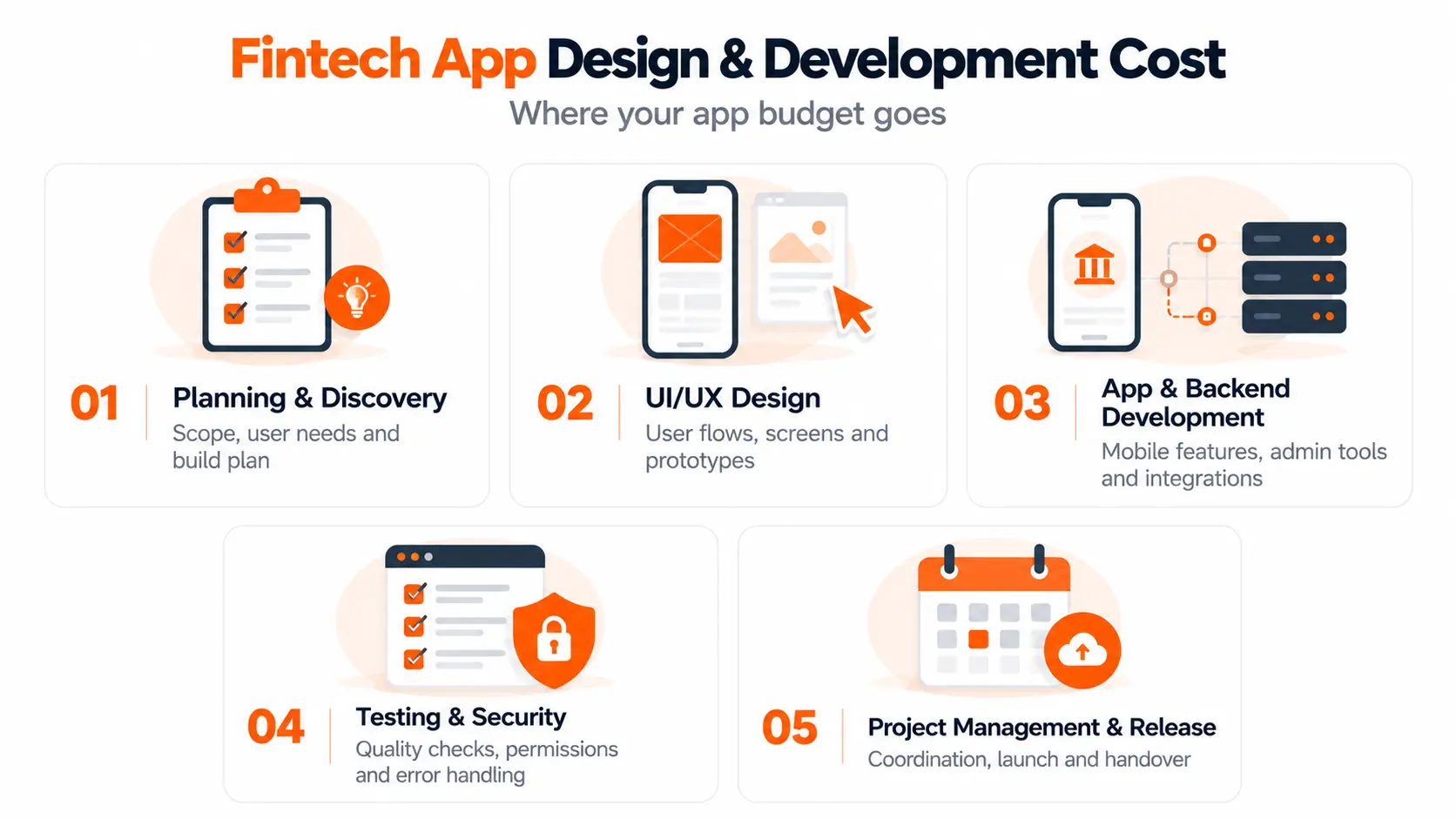
Fintech app design and development cost includes several kinds of work. A clear quote shows what each part delivers and which items sit outside the total.
Planning and Discovery
The team first agrees on the users, their main task, and the features needed at launch. They also check data sources, payment providers, and the rules that may affect the product.
The result should be a clear scope, a list of key risks, and a build plan. This work helps uncover missing tasks before they become expensive changes.
UI/UX Design and Prototyping
Design covers the steps people take as well as the screens they see. Clear UI/UX design helps users understand fees, check details, and spot mistakes before they confirm an action.
The work can include user research, wireframes, screen designs, a clickable prototype, and user testing. Designers also need to show what happens when a payment fails, a check is delayed, or a connection drops.
For illustration, 160–400 design hours at $50 per hour would cost 8,000–20,000. That is a design-only calculation for a limited scope. A larger product can need much more work.
If design is already included in the full build quote, do not add it again.
App, Backend and Integration Development
Developers build the mobile screens and the backend: the systems that store data and run the app's rules. They connect outside services and create tools for staff.
An admin dashboard may let staff review cases, manage access, and help users. That web application development work belongs in the budget even when customers only use the mobile app.
Quotes should cover the work behind normal actions too. A transfer, for example, needs clear handling for delays, failures, and duplicate requests.
Testing, Security Checks and Launch
Testing checks whether the app works across its supported devices and user journeys. The team should test permissions, calculations, connections and error handling throughout the build.
Security reviews, release setup and handover also need time. Ask which checks the team performs and whether an independent security assessment is priced separately.
Project management should be visible in the quote. Someone needs to track decisions, manage changes, and keep the work moving.
A Simple Fintech App Budget Example
Imagine a personal finance MVP with expense tracking, one bank-data connection, savings goals, alerts, and a basic admin dashboard. It does not move money or make lending decisions.
Here is an illustrative allocation using the same $50 hourly rate:
An assumed 10% reserve would add $9,000, bringing the planned build budget to $99,000. This reserve is a choice for the example, not a rule for every project.
Provider charges, external assessments, and running costs remain separate. This is a planning model, not a Brightin Studio project quote.
What Affects the Cost of a Fintech App?
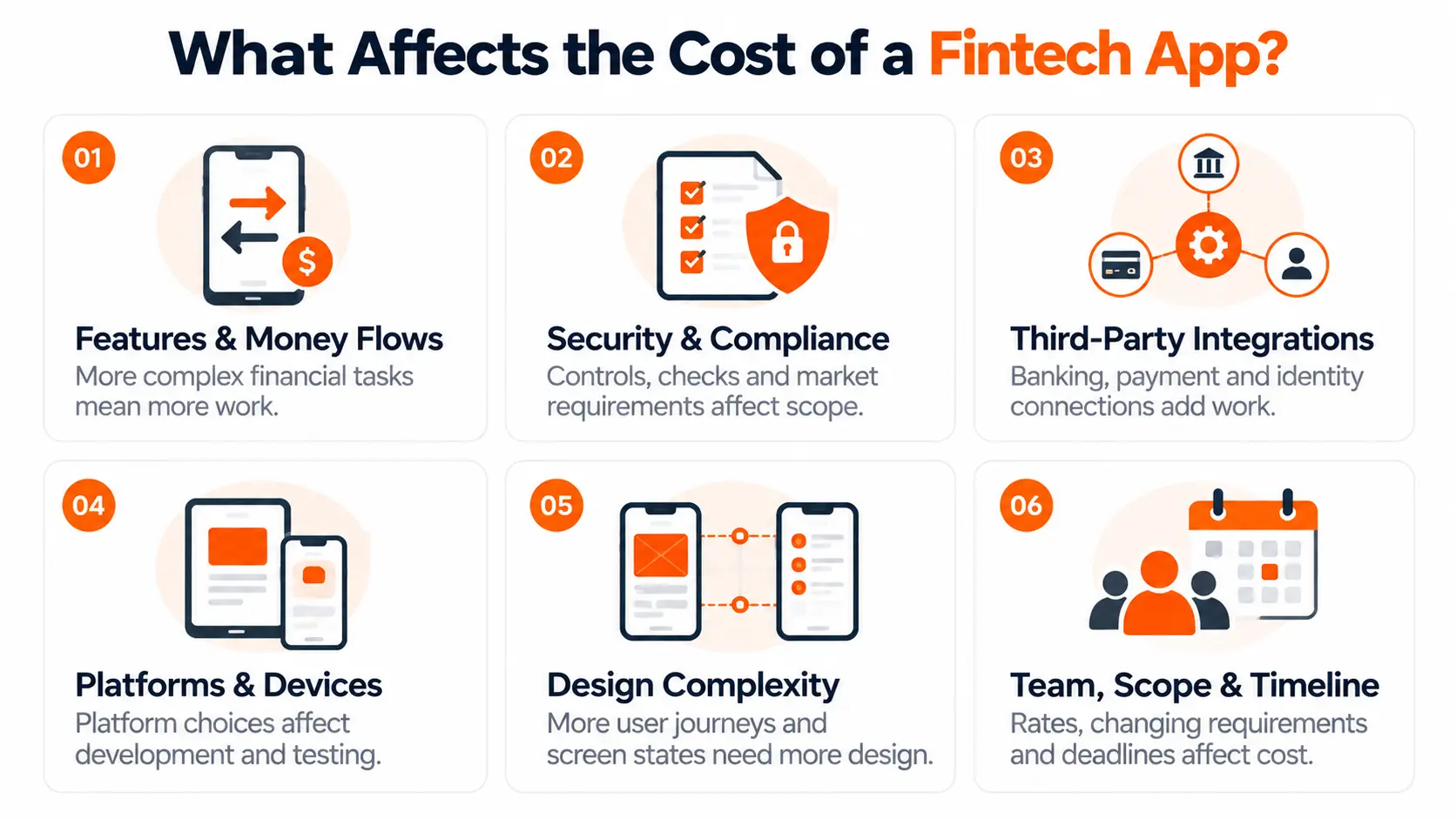
The budget changes when the team has more work to design, build, test, or support. These six areas explain many of the differences between quotes.
Features and Financial Workflows
Showing a balance is simpler than moving money between accounts. A transfer may need checks, status updates, refunds, and matching records across systems.
More currencies, account types, or user roles add work. Staff also need ways to solve problems when an automated step fails.
Estimate a feature as a full journey. Include what happens before the user taps a button and what staff must do afterwards. Screen count alone will miss much of this effort.
Security and Compliance Requirements
The app's purpose, data and target markets shape its needs. Access controls, secure data handling, audit records and testing all take time.
For fintech software development in the UK, the budget should reflect the activities the business will carry out. The FCA's authorisation guidance explains how to check whether those activities need authorisation or registration.
A software quote does not itself grant permission to offer a financial service. Separate the engineering work from legal advice, applications and ongoing compliance duties. Check those needs early so they can shape the build.
Payment, Banking and Identity Integrations
An API lets your app exchange data with another service. Connecting one still involves setup, data mapping, error handling, and tests.
A provider may also need to approve your business before you can go live. Ask what access is needed and who will arrange it.
Identity checks, often part of Know Your Customer work, can involve both integration costs and fees for each check. Payment services may charge by transaction. Keep those usage fees separate from the cost of writing the connection.
iOS, Android and Cross-Platform Development
Native apps are built separately for iOS or Android. Cross-platform tools let teams share some code between them, though device features and testing still need attention.
The right approach depends on what users need, the providers you use and the skills available to maintain the app.
When comparing mobile app development in the UK, ask each team to price the same platform scope. A quote for one app cannot be fairly compared with a quote covering iOS, Android and staff tools.
Design Complexity
A simple design can still involve complex decisions. Users may need to review a fee, correct a payment detail or recover access to an account.
Each state needs clear text and a useful next step. More languages, screen sizes and accessibility needs add work too.
A shared set of design components can reduce repeated effort. It will not remove the need to test whether people understand the financial choices shown to them.
Team Rates, Scope Changes and Delivery Time
Compare total effort as well as hourly rates. A low rate loses its value if the team must repeatedly rebuild work.
Some products need both customer apps and browser-based staff tools. If you are sourcing web app development in the UK alongside mobile work, agree who owns the shared backend and testing. This helps avoid gaps or duplicate charges.
Keep scope changes visible. Before adding a feature, ask how it affects cost, testing, and the release date. Provider approval delays should also be tracked separately from active build time.
How Much Does a Fintech App Cost After Launch?
Launch starts a new set of costs. The app needs hosting, monitoring, updates, and support. Some bills grow with use; others depend on the service level you agree with your team.
For example, Stripe Identity offers verification pricing based on use, with custom pricing options. That bill is separate from the work needed to connect the service to your app.Build a monthly forecast around expected activity. Include users, checks, transactions, stored data, and support hours. Then test what happens if those numbers grow.
For a simple illustration, 40 support hours at the assumed $50 rate would cost $2,000 per month, or $24,000 per year. This is labour only. Cloud bills, provider fees, and external reviews would be extra.
Ask what the support agreement includes. Bug fixes, operating system updates, new features, and urgent incidents may have different terms. A fixed percentage of the original build price will not explain all these costs.
Check for minimum monthly bills and paid add-ons before choosing a provider. A low fee per transaction may come with other charges. Your forecast should use the full terms of the plan you can buy in your target market.
How to Reduce Fintech App Development Costs
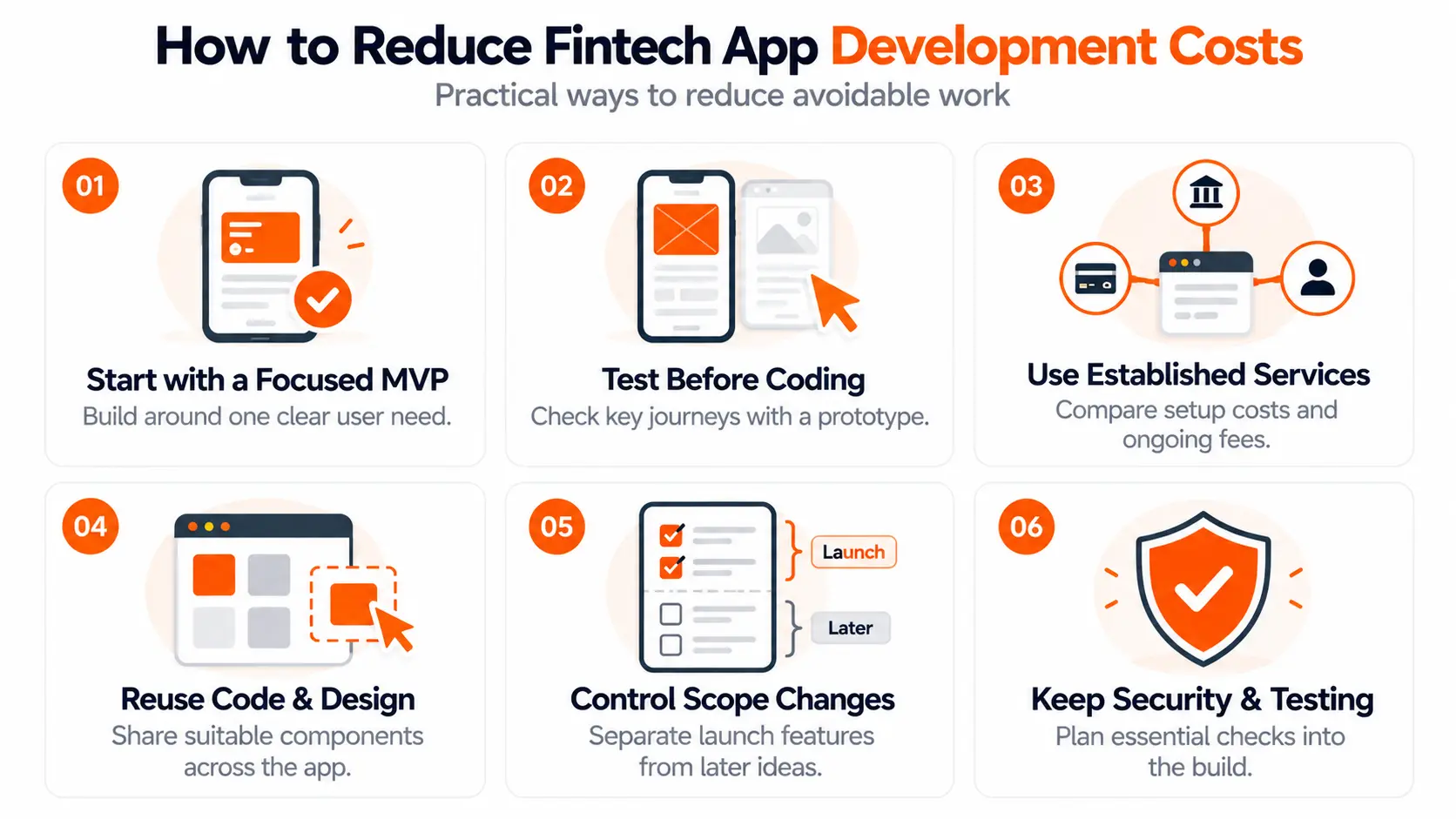
The most useful savings come from reducing avoidable work while keeping the product fit for its purpose.
Start with one clear outcome. Choose the task that users most need to complete. A focused MVP development budget gives you room to learn before funding a larger feature list.
Test the main journey before coding. Use mobile app prototyping tools to check steps such as sign-up, reviewing a fee and confirming an action. Fixing a confusing flow at this stage can prevent later rework.
Use established services where they fit. Payment, identity and messaging providers can reduce custom work. Compare setup costs, usage fees and the effort of changing providers later.
Share code and design where useful. Reusable components and a suitable cross-platform approach can reduce repeated tasks. Check that required device features and provider tools still work well.
Control changes during the build. Keep a launch list and a later list. Review the cost of each change before approving it. Small additions can affect several screens and tests.
Keep essential security and testing in scope. It is more useful to launch with fewer well-tested features than to stretch the same budget across unfinished work.
What to Include in a Fintech App Cost Estimate
Send each potential partner the same short brief. It should explain:
- Who will use the app and the main task it solves.
- Which countries and platforms the first release will support.
- The features and user roles needed at launch.
- Whether the product moves money, reads financial data or manages applications.
- The providers, systems and data sources it must connect to.
- Whether designs or a prototype already exist.
- The admin tools, testing and support you need.
- Your target date and any provider approval steps.
Ask for a quote that separates design, development, testing, release and ongoing costs. It should state assumptions, exclusions, payment stages and how changes are priced.
Check the handover too. Source code, designs, accounts and setup notes should have clear owners. A useful estimate explains what you will receive and what your team must supply to keep the project moving.
If one quote is much lower, ask which tasks it leaves out. Design revisions, data migration, staff tools and release support are worth checking. Resolve those gaps before comparing the final totals.
Frequently Asked Questions
How much does it cost to design a fintech app without development?
Using the example rate in this guide, 160–400 design hours would cost 8,000–20,000. The actual effort depends on research, user journeys, screen states, and testing. Confirm whether the quote includes a clickable prototype, design files, and developer handover. A prototype can show how the app will work, but it does not provide a live backend or process real transactions.
How long does it take to build a fintech app?
For initial planning, allow roughly three to six months for a focused MVP. A broader product may need six to twelve months or longer. These are working allowances, not delivery promises. Team size, scope, testing, and provider access affect the schedule. Any required business approval can follow a separate timeline, so agree what must be ready before launch.
Is a white-label fintech app cheaper than a custom app?
A white-label product can reduce initial build work because you adapt an existing system. However, setup fees are only part of the price. Compare subscriptions, transaction charges, branding limits, custom changes, and data export options. It may suit a standard service. A custom build may fit better when your main user journey cannot work well within the provider's product.
Does using a payment provider cover all compliance work?
No. A provider can handle agreed parts of the payment process, but responsibilities depend on your business activity, market, contract, and technical setup. You may still have duties around customer data, access, checks, and records. Confirm which tasks belong to each party before signing the development scope. Include the work and advice needed to cover any remaining gaps.